
In-depth Yoga education, grounded in the Iyengar® Yoga method. Explore Yoga through the perspectives of Yoga Studies and contemporary scientific research—and bring these insights into immersive live practice.
Yoga Unfolded brings in-depth Yoga study — through Video Series, Podcasts and Papers — into dialogue with Iyengar® Yoga practice , explored through the Thematic Library, Live online sessions and Recordings.
Create a free Starter account to explore a selection of Videos, Podcast episodes and Papers, and stay up to date with new releases, Live sessions and Events. Choose a Membership for broader access to the platform’s content and practice.


Interview with Dr. Daniela Jurisic
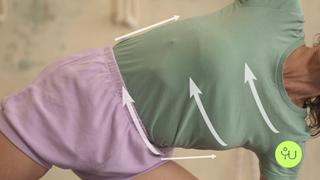
Ep.2 - Utthita Trikonasana
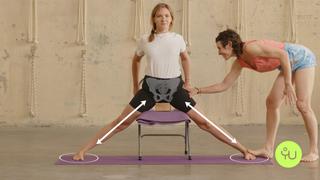
Summer extend&compact sequence


Meet Patanjiali - Trailer

Salus per Yoga - Trailer
From Seeing to Sensing
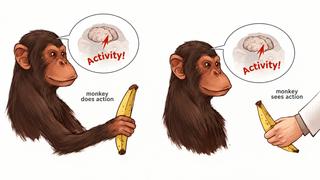
Starting from an observation by Iyengar Yoga teacher Jawahar Bangera, this paper asks how an observed movement becomes an embodied motor skill. Research on the mirror mechanism shows that action observation can engage motor representations in the observer, while studies of motor expertise indicate that this response is shaped by the observer’s existing motor repertoire. Yet seeing is not sufficient for learning. Contemporary sensorimotor research describes skilled action as a continuous interaction among motor commands, prediction, multisensory feedback, error detection and adaptation. Using Trikoṇāsana as an example, the paper proposes that Iyengar Yoga practice can be understood as an iterative educational process in which demonstration and verbal instruction orient action, while proprioceptive, tactile, visual and vestibular information allow the practitioner progressively to perceive and refine that action from within. This does not reduce B.K.S. Iyengar’s idea of “intelligence in action” to a neuroscientific mechanism; rather, it identifies an illuminating parallel between his pedagogy and contemporary accounts of sensorimotor learning.
Spring blooming sequence
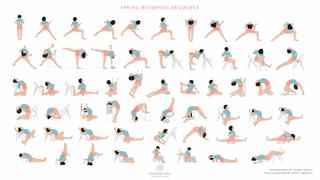
The Spring Blooming Sequence focuses on awakening and expanding the heart–chest region, inspired by the natural renewal and vitality of the spring season. Through specific yogāsana and prāṇāyāma practices, the sequence aims to create space in the thoracic area, supporting healthy posture, diaphragmatic movement, and circulation. Particular attention is given to the relationship between posture, emotional states, and the regulation of the autonomic nervous system. By encouraging openness in the chest and balanced breathing, the practice seeks to foster psychological lightness, resilience, and a sense of vitality. In this way, the sequence supports the broader goal of yoga as a lifelong practice of self-regulation and physiological balance.